Playing Final Fantasy XIII in 2026: Part 1 – A Retrospective on Cocoon’s Controversial Legacy
Final Fantasy XIII has occupied a quiet corner of my mind for nearly fifteen years. It wasn’t that I didn’t want to play it; it was that I always meant to finish it. Having journeyed through almost every other mainline entry, XIII remained a “white whale” for me. So, in 2026, I finally sat down and committed to seeing the journey through to its end.
Coming back to it today, removed from the heated “corridor” debates of 2010, reveals a game that is much more than its reputation suggested. It is a focused, high-stakes cinematic experience that feels surprisingly refreshing in an era of bloated open-world titles.
Visuals and Performance: A 15-Year-Old Masterclass
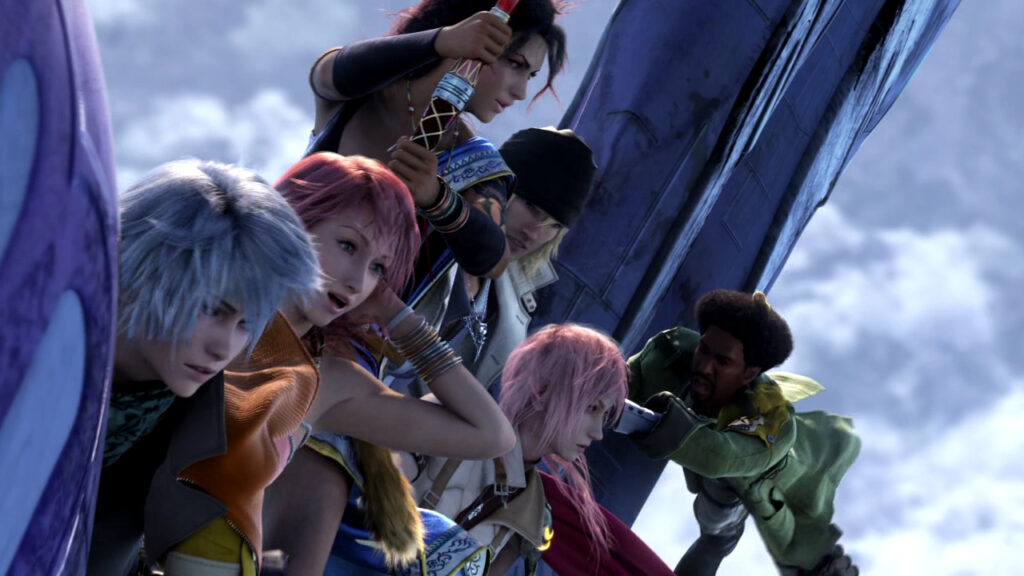
Visually, the game holds up with startling grace. Running on a modern PC, the Crystal Tools engine delivers a level of detail that puts many modern Triple-A titles to shame. The art direction is a masterclass in sci-fi fantasy, blending the clinical, floating heights of Cocoon with the rugged, alien wilds of Gran Pulse.
The engine itself has a fascinating history. Originally, Final Fantasy XIII was intended to be a PlayStation 2 title. However, after Square Enix showcased a breathtaking technical demo at E3 2005, the public reception was so massive that the developers realized they couldn’t stay on the older hardware. They made the bold, and at the time, grueling decision to jump to the PlayStation 3, effectively birthing the Crystal Tools engine to support their ambitious “ultimate cinematic” vision.
The cinematic direction is where the game truly shines. Whether it’s in-game dialogue or pre-rendered cutscenes, the sense of scale is immense. Interestingly, playing it now, I can see how modern titles like Clair Obscur: Expedition 33 have clearly drawn inspiration from XIII’s aesthetic DNA and structural flow.
The Human Drama: A Party of Traumatized Fugitives
What stands out most in 2026 isn’t just the world, but the raw interpersonal friction between the characters. Unlike the “found family” tropes of other RPGs, this group starts off broken.
The Hope and Snow Conflict
The relationship between Hope and Snow is the emotional anchor of the first half. Hope’s quiet, simmering hatred for Snow—whom he blames for his mother’s death during the Purge—creates a palpable tension. The moment in Palumpolum where Hope finally confronts Snow, knife in hand, is one of the most grounded depictions of grief in the series. It shifts the story from a generic “save the world” plot to a deeply personal study of loss and misplaced blame.
Sazh and Dajh: The Father’s Burden
Then there is Sazh. While he initially seems like the comic relief, his arc is perhaps the most heart-wrenching. His desperate quest to save his son, Dajh, from becoming a mindless Cie’th provides the most relatable stakes in the game. In 2026, his struggle against a system (the fal’Cie) that uses children as pawns feels more poignant than ever.
The Turning Point: Fang’s Impact
Before reaching the desolate ruins of Oerba, we see the party’s internal pressure boil over. A standout moment is the confrontation between Fang and Lightning. Fang, desperate to save Vanille, loses her cool, leading to the infamous scene where she slaps Lightning to snap her out of her own stoicism. This is pivotal; it’s the moment the party stops reacting to their “Focus” and starts challenging each other to be better.
Mechanics: The Rhythm of the Paradigm Shift
The combat remains the undisputed star. It’s fast, aggressive, and feels significantly more modern than the systems in FFXII. The Paradigm system shifts the player’s focus from micromanagement to macro-strategy. You aren’t just choosing “Attack”; you are conducting an orchestra of roles.
The Stagger mechanic forces a level of aggression rarely seen in turn-based games, and because the game doesn’t pause while you’re navigating menus, the tension in boss fights remains high. It requires quick thinking and a deep understanding of your party’s synergy.
The Lore Barrier and Sid Raines
If there is a hurdle, it remains the “Lore Barrier.” The early hours bombard you with terminology—l’Cie, fal’Cie, Focus—without much context. However, characters like Sid Raines help bridge that gap. As a high-ranking official who realizes humanity is being treated as livestock by the gods, his tragic rebellion adds a layer of political intrigue that makes the “abstract” lore feel much more concrete.
Final Fantasy Fun Facts
- The Engine: The game runs on Square Enix’s proprietary Crystal Tools, which was so ambitious it was intended to power FFXIV and the original Versus XIII (which eventually became FFXV).
- The Voice of Lightning: Actress Ali Hillis brings Lightning to life. RPG fans might also recognize her as the voice of Dr. Liara T’Soni from the Mass Effect trilogy.
- A Musical Departure: This was the first major Final Fantasy to move away from series legend Nobuo Uematsu, allowing Hamauzu to define a new, more experimental sound for the franchise.
- The Vision: At launch, Square Enix marketed XIII as the “ultimate cinematic RPG,” prioritizing a directed, emotional experience over the sprawling exploration of previous generations.
Final Verdict: Is it Worth Playing in 2026?
As I arrived at the hauntingly beautiful ruins of Oerba, I realized that Final Fantasy XIII is a game that knows exactly what it wants to be. It doesn’t try to cater to every RPG whim; it commits to its specific vision of cinematic combat and tight narrative focus.
In 2026, that focus is its greatest strength. If you can push through the initial terminological confusion and the linear paths of the first few chapters, you’ll find one of the most emotionally resonant and visually stunning entries in the entire Final Fantasy franchise.
It’s not just an RPG; it’s an experience that asks you to settle into its rhythm. Once you do, the journey is well worth the time.
Media Credits: Special thanks to Redcrown for the Final Fantasy XIII high-quality screencaps and media assets. Website: https://xiii.redcrown.net/series
© 2009-2026 SQUARE ENIX CO., LTD. All Rights Reserved. FINAL FANTASY is a registered trademark of Square Enix Holdings Co., Ltd.